Friday, July 26, 2013

Taxes-Planning Strategies

We at Paragon Financial Advisors are not accountants and urge you to verify any items we discuss with your tax professional to determine its implications in your particular situation. We also do not believe you should “let the tax tail wag the investment dog.” That is, your investing should not be dependent solely on tax considerations. However, tax consequences certainly should be considered when all other things are equal. Taxes can have a significant impact on your total economic well-being. It is in that spirit that we discuss the Congressional resolution (enacted at the last minute) to the fiscal cliff.

In our past blogs, we have discussed quite a few items pertaining to the resolution of the debt situation currently facing the US. We would encourage you to read those blogs as they lead to the suggestions we make here on ways to prepare for your future. Some of these suggestions are to avoid known items of tax increase and some are designed to position you for changes that may be forthcoming in an environment where Congress is seeking additional revenues. Consider the following:

  • Utilize strategies to reduce taxable income, thereby avoiding higher tax brackets on ordinary income/capital gains/interest/ and the 3.8% health care tax.
    • Maximize contributions to retirement plans, IRA’s, FSA’s, HSA’s, etc.
    • Seek deferred compensation agreements with your employer if available.Maximize the use of tax deduction strategies (charitable contributions, mortgage interest, etc.)
  • Consider Roth strategies (contributions, conversions, Roth 401(k)) as a way to hedge against future tax increases.
    • Consider a Roth IRA conversion if below the income thresholds.
    • Investigate Roth conversion options in 401(k) plans which have now been expanded to include all participants.
  • Invest in municipal bonds to generate tax free income (in taxable investment accounts).
    • Extremely favorable for those in higher tax brackets especially since municipal interest is currently free from income tax as well as the 3.8% health care surtax.
  • For those over age 70 ½ who face required minimum distributions from IRA’s, make donations to qualifying charities from the RMD amount (up to $100,000 maximum in 2013) as a way to avoid the RMD from increasing your taxable income.
  • Consider the sale of appreciated assets (or gifting assets to other family members in lower tax brackets) to take advantage lower capital gains rates (0% or 15%).
  • Considering the low interest rate environment, do some of the estate planning techniques (such as a Grantor Retained Annuity Trust) make sense for you?
  • Consider, if appropriate, some of the advanced wealth transfer strategies (grantor trusts, dynasty trusts, family limited partnerships, etc.) while these strategies are still available.
As usual, we at Paragon Financial Advisors are here to assist you and your family in the long range planning of your financial well-being. Please do not hesitate to give us a call.

Thursday, July 18, 2013

Pensions To Lump-sums

Retirees from large companies who have been drawing retirement checks may face a new option. Their former employer may offer to swap them a lump sum payment now in exchange for all future retirement checks. An interesting offer but one that requires very close scrutiny.

First of all—why is the past employer making such and offer? Pension payments are generally made from defined benefit plans, i.e. plans that guarantee the retiree a prescribed benefit based on retirement age, length of employment service, and salaries earned while working. Note here that the employer is bearing all investment risk—the employer must contribute enough money into the plan such that the contributions plus investment earnings will provide the retirement benefits to the retiree over his/her expected lifetime. National media stories are abounding about corporate retirement plans and their underfunded status(i.e. the plans do not have adequate assets to meet the projected pension obligations). That problem has been compounded because the estimated plan earnings assumption has been very difficult to achieve for many plans because of investment performance over the past decade.

Another change working in favor of the employer is a change in allowable interest rates for lump sum calculations. The basic assumption in a lump sum distribution is that the employer will provide the retiree a lump sum of money that can be invested by the retiree to replicate the pension payment stream over the retiree’s life expectancy. The lower the interest rate assumption, the greater the amount of lump sum dollars that were required. Historically, US Treasury security interest rates were the assumed interest rates for lump sum calculations. Plan administrators can now use corporate bond interest rates in their lump sum calculations; those corporate bond interest rates are higher than the Treasury securities. The net impact—the higher the assumed interest rate, the lower the amount of lump sum dollars needed.

The bottom line—some pension plan administrators are attempting to remove retirees from their plans and the offer may not be in the best interest of the retiree. Should you or someone you know face such a choice, we at Paragon Financial Advisors will be happy to assist you in analyzing this decision.

Friday, July 12, 2013

Happy Days Are Here Agian??

The stock market is bumping up against all-time highs. The question is why. Are these legitimate levels based on fundamentals or is the excessive liquidity being pumped into the money supply simply going into stock because it’s the better (?) place now. David A. Rosenberg (Chief Economist & Strategist) at research@gluskinsheff.com had some interesting comments in his Economic Commentary of March 25, 2013. He commented on the lack of economic recovery (“… the worst recovery in recorded history.”) and gave the following statistics:
  • Industrial production: -1.2% (1.2% lower than the previous cycle peak)
  • Manufacturing output: -4.3%
  • Real manufacturing and trade sales: -1.7%
  • Total payrolls: -2.2%
  • Full time employment: -5%
  • Real personal income ex transfers: -4.5%
  • Real disposable personal income per capita: -6.2%
And this performance is in the wake of:
    • Four years of $1 trillion deficits
    • Four years of 0 interest rate policies
    • A tripling of the Fed balance sheet (QE1, QE2, Twist, QE3, etc.
    • Bailout stimulus

Hummm-let me think about that!!!

Wednesday, July 3, 2013

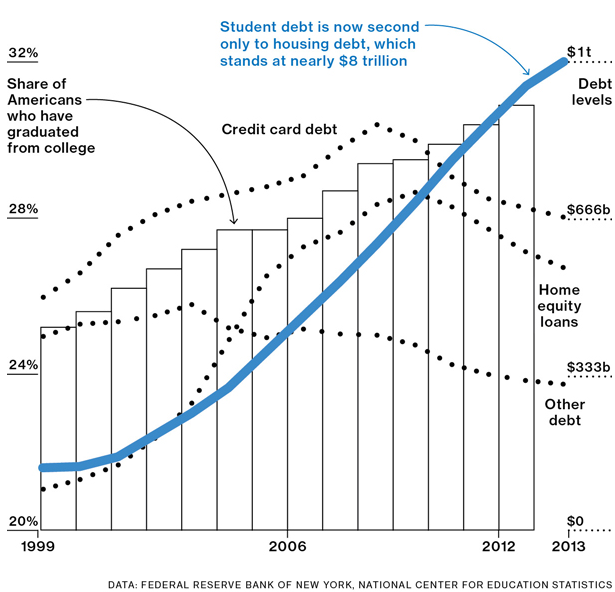
Shocking Trends in College Expenses and College Debt Necessitate Earlier Planning for Families


The July 2013 issue of Bloomberg Businessweek found HERE includes troubling trends in college expenses as originally presented by the Federal Reserve Bank of New York, National Center for Education Statistics.  Since 1999 and adjusted for inflation, tuition has increased more than 50%.  As costs continue to rise, if sources of college funds fall short of what is needed, student loans are taking up more of the slack.

The problem is magnified by the fact that congress missed the deadline for making a change on July 1st meaning the subsidized Stafford loan rate has doubled from 3.4% to 6.8%.

What can you do?  Saving for future college costs can seem ominous but there are things you can do now to get a jump start.  Always discuss any options presented with your financial advisor prior to acting.

529 College Savings Plan – Numerous states sponsor 529 College Savings Plans through various institutions.  A 529 plan is a great way to begin savings for college.  Contributions for 2013 can be as much as $14,000 per donor for a child ($28,000 for a married couple).  There is a 5-year rule allowing donors to make contributions of $70,000 per donor for a child ($140,000 for a married couple).  Using this rule the one-time gift is treated as having been contributed over a 5 year period.  There are several planning strategies that can be utilized with this type of account.

Coverdell Education Savings Account – While not as generous as the limits for a 529 plan, the Coverdell Education Savings Account (ESA) is another potential savings vehicle allowing the accumulation of assets on a tax free basis if used for college.  For 2013, individuals may contribute as much as $2,000 to a Coverdell ESA if they qualify under the income limitations.

Scholarships – Seek out scholarship opportunities diligently.  Begin compiling a list of possible avenues now and continue to add to the list as you find new opportunities.  Research what is required for each one and work with your child to ensure they are not just eligible but hopefully near the top of candidates applying.

Grants – If you qualify for grants, by all means accept them!  If you need help with the FAFSA process find a financial advisor in your area who is knowledgeable about college financial aid.

Part-time employment during high school and college – Although it may not be an answer for everyone, consider encouraging the student to contribute towards their future by partially paying their own way. 

Encourage an entrepreneurial spirit in kids – Children are creative beings, capable of so much.  Encourage them to realize their potential through setting a good example.  Find a mentor or teacher who can help them develop ideas into potentially viable businesses that could succeed beyond expectations.

Most importantly, begin saving and preparing now instead of waiting.  Every dollar contributed helps towards the end goal.  Structure a proactive plan of seeking out opportunities and saving early so there is less reliance on student loan debt which is becoming more unreasonable.


Applegate, Evan. "Correlations: Student Debt Explodes." Bloomberg Businesswek. 1 July 2013: Page 18. Print.
Applegate, Evan. "Correlations: Student Debt Explodes." Bloomberg Businesswek. 1 July 2013. www.businessweek.com Web. 2 July 2013
 

Friday, June 28, 2013

Taxes-Estate and Gift


We at Paragon Financial Advisors are not accountants and urge you to verify any items we discuss with your tax professional to determine its implications in your particular situation. We also do not believe you should “let the tax tail wag the investment dog.” That is, your investing should not be dependent solely on tax considerations. However, tax consequences certainly should be considered when all other things are equal. Taxes can have a significant impact on your total economic well- being. It is in that spirit that we discuss the Congressional resolution (enacted at the last minute) to the fiscal cliff.

One of the more favorable (relatively) aspects of the American Taxpayer Relief Act of 2012 was the impact on estate and gift taxes. Prior to this act, estate tax rates were scheduled to rise to a maximum tax rate of 55% and the exclusion amount from this tax was to fall from $5.1 million per person to $1 million per person. With the 2012 Act, the exclusion amount was made permanent at $5 million indexed for inflation (the current amount for 2013 is $5.25 million). The tax rate, however, was raised from 35% to 40%.

Another permanent aspect of the ’12 Act was the provision of “portability.” Portability simply allows the surviving spouse to utilize the deceased spouse’s unused portion of the exclusion amount without the necessity of utilizing trust arrangements. This concept appeared in 2011, but was made permanent in 2012. It is important to note that this portability applies only to the last deceased spouse so, for multiple marriages, some planning pitfalls appear.

While the exemption amount remained higher and the tax rate lower than many had expected, there are other estate planning techniques that are still “at risk.” Some trust planning techniques ( such as grantor retained annuity trusts—GRAT’s) and the discount valuations for family limited partnerships (FLP’s) may be in danger; hence, there is some urgency in implementing those types of plans if appropriate.

As usual, we here at Paragon Financial Advisors remain available to assist you in working with your legal professional as you complete your estate planning. Please do not hesitate to call on us.

Monday, June 24, 2013

Paragon Perspectives


In this month’s edition of Paragon Perspectives advisor, Jene Tebeaux, commentates on three articles concerning risk.  The first is risk in relation to natural disaster planning, followed by risk in the current market conditions, and lastly how to evaluate your portfolio’s risk from two points of view.
 
June is the beginning of hurricane season along the Gulf Coast. In light of last year’s events (Hurricane Sandy, et al, and tornadoes in Oklahoma), we thought a discussion on disaster planning as it relates to your financial affairs would be appropriate.   The underlying theme for our second quarter newsletter is how our investment portfolios can be affected by unforeseen events and what we might do to mitigate those risks. The time to plan for natural disaster events is before the execution of such a plan is necessary. 
 
When planning for the unexpected in turbulent markets, the risk of sudden change is something that investors need to be aware of. Our current economic climate certainly has the potential for major change: Is the stock market overpriced? Will the Fed reduce QE (quantitate easing)? All factors are in place for an “interesting” time in the financial markets.  This edition of Paragon Perspectives discusses some of the things to keep in mind during such times.
 
Lastly we discusses “risk” and suggest that an investor needs to evaluate portfolio risk from two points of view: 1) the investor’s capacity (ability) to assume risk (i.e. level of assets vs. desired goals), and 2) the investor’s tolerance (willingness) to assume risk. Sometimes these two points of view do not agree for a specific investor. In such cases, the investor needs to reconcile these differences.
 
If you would like to read the newest edition of Paragon Perspectives but did not receive a copy, please email info@paragon-adv.com to request the newest edition of our newsletter.


Wednesday, June 19, 2013

Taxes-Health Care

We at Paragon Financial Advisors are not accountants and urge you to verify any items we discuss with your tax professional to determine its implications in your particular situation. We also do not believe you should “let the tax tail wag the investment dog.” That is, your investing should not be dependent solely on tax considerations. However, tax consequences certainly should be considered when all other things are equal. Taxes can have a significant impact on your total economic well-being. It is in that spirit that we discuss the Congressional resolution that provided the Health Care Act (sometimes called “Obamacare.”).

One of the Congressional leaders advised that “…we should pass the bill so we can see what’s in it…” and she was absolutely right—it has some tax implications on investments that are worth noting. In our third quarter of 2012 newsletter, we mentioned some of the provisions of this law. We will summarize some of the more investment related impacts again here:
  • There is a 3.8% Medicare surtax on “net investment income” beginning in 2013. This surtax affects taxpayers with a modified adjusted gross income of $200K for singles or $250K for couples.
  • It affects interest, dividends, capital gains, annuity income, rental income, and royalties. Business income from “passive” activities is also affected.
  • Interest income from municipal bonds is excluded.
  • Retirement plan distributions are not subject to the surtax; however, such retirement plan distributions can increase a taxpayer’s income over the threshold levels.
  • There is an additional payroll tax of 0.9% on workers earning more than $200K for singles or $250K for couples.
So what happened with all these changes? The top tax bracket went from 35% to over 43.4% (39.6% + 3.8% for health care + the phase out of deductions—see our previous blog). Capital gains tax rates went from 15% to 23.8% (20% for capital gains + 3.8% for health care –a whopping 59% increase in the tax rate). Oh, and by the way, not all of the health care costs are being included yet—some don’t become effective until 2014!!

As always, please feel free to contact us here at Paragon Financial Advisors if you have questions about providing for your long term financial security.